WILMINGTON, DE, UNITED STATES, July 2, 2026 /EINPresswire.com/ — The modern landscape of residential property management faces intense operational challenges due to changing climate patterns. Extreme seasonal heatwaves and severe winter blizzards place immense stress on central utility grids worldwide. During peak demand periods, aging substations frequently fail, leaving millions of residents without primary electricity. Consequently, integrating a High Capacity Portable Power Station into standard domestic preparedness protocols has become crucial. These self-contained mobile utility systems offer immediate relief from unpredictable grid failures without requiring extensive infrastructural changes. Property owners can establish a reliable defense system against prolonged blackouts by transitioning to modern decentralized storage technology. This shift represents the dawn of the personal domestic microgrid era.
The Infrastructure Deficit: Why Outdated Grids are Forcing the Rise of Personal Microgrids
Centralized electrical distribution networks suffer from systemic structural vulnerabilities. Most municipal grids rely on equipment that engineers built decades ago. Because of this aging infrastructure, concurrent demands from residential air conditioning systems can overwhelm neighborhood transformers during seasonal heatwaves. Furthermore, violent convective storms and heavy snowfall physically down transmission lines, creating widespread blackouts that last for days. These recurring utility failures demonstrate the clear limits of centralized energy systems. Therefore, modern families actively abandon passive reliance on public utilities. Instead, residential consumers choose proactive self-sufficiency by deploying personal microgrids inside their living spaces. A localized energy system ensures that vital household services continue running during a widespread grid collapse. This shift from public reliance to private storage secures daily comfort and preserves essential communication channels during an unexpected emergency.
Decoding the 1kWh/1800W Equation: The Engineering Divide in Modern Domestic Resilience
When building a residential energy reserve, selecting the correct technical specifications dictates overall operational success. Industry experts identify the one-kilowatt-hour capacity paired with an 1800W inverter as the ideal performance threshold for indoor deployment. This specific combination creates an optimal balance between physical portability and high power delivery. On one hand, smaller pocket power banks lack the necessary capacity to sustain household loads for more than a few hours. On the other hand, heavy industrial backup systems provide massive reserves but remain fixed in place due to their extreme weight. Furthermore, a robust 1800W pure sine wave inverter easily handles heavy inductive and thermal loads. This power level allows users to run ninety-nine percent of standard kitchen appliances safely. For example, high-draw items like coffee makers, microwave ovens, and full-sized refrigerators operate smoothly without overloading the system. This specific energy metric provides complete multi-room utility during extended electrical outages.
The Residential Microgrid Checklist: Architectural Standards for Indoor Energy Hubs
Discerning consumers must evaluate domestic energy investments using strict engineering criteria rather than persuasive retail advertising. A dependable indoor power hub must fulfill several rigorous technical benchmarks to guarantee safe operation under extreme environmental stress.
First, the system requires substantial inverter headroom paired with advanced surge mitigation circuits. Motorized appliances demand intense momentary currents when starting their internal mechanisms. Therefore, the internal circuitry must absorb these transient spikes seamlessly to prevent sudden safety shutdowns.
Second, the storage core must deliver excellent electrochemical life cycles and strong thermal runaway defenses. Since operators deploy these devices inside residential living spaces, the internal battery chemistry must remain stable across variable indoor temperatures.
Third, the physical layout must facilitate effortless intra-household kinetic ergonomics. Property owners must avoid bulky, immobile hardware assets that lock power into a single room. Instead, an optimal setup balances robust capacity with a compact form factor to permit rapid manual transportation between separate living zones.
Technical Audit of the GEYOTO N1000: The Decentralized Power Core Designed for Fluid Indoor Mobility
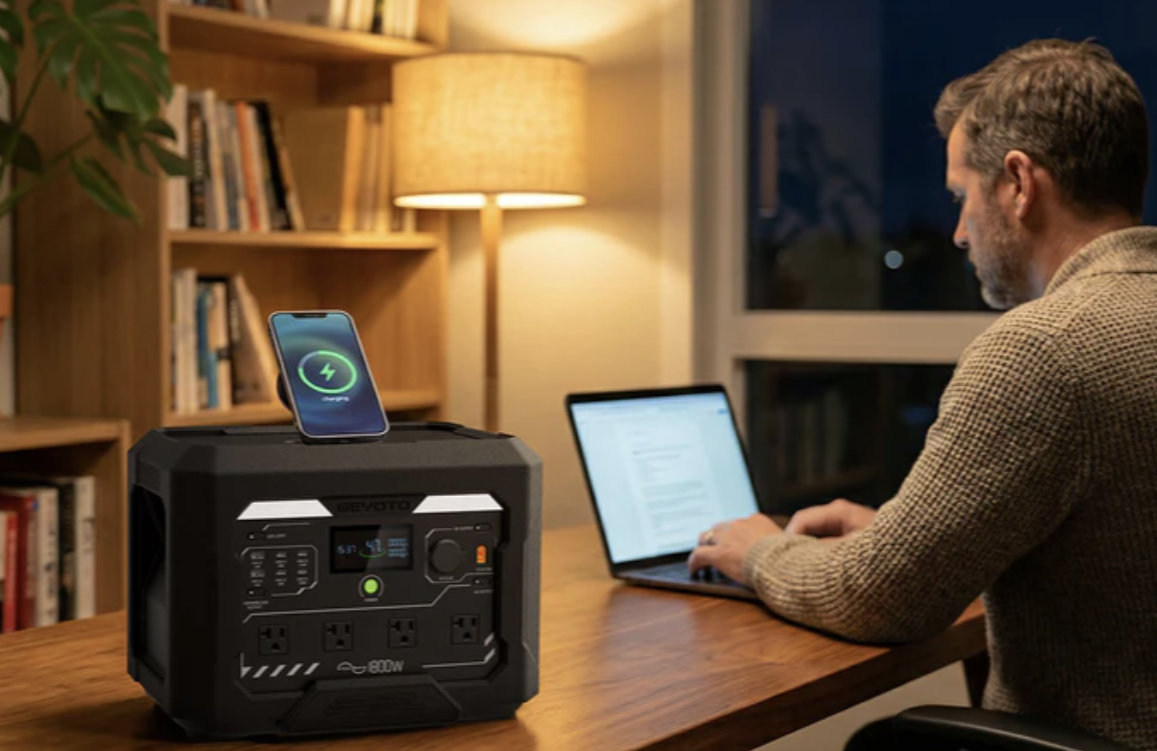
The N1000 mobile generator by GEYOTO addresses these complex indoor engineering requirements directly through an optimized hardware design. This compact utility hub carries a substantial 1024Wh capacity paired with a heavy-duty 1800W pure sine wave inverter. Because the system utilizes a pure sine wave configuration, it delivers clean, stable electrical waves to protect delicate home microprocessors. Families can run high-wattage kitchen appliances and sensitive medical CPAP hardware concurrently without experiencing voltage drops. Furthermore, the physical chassis balances weight and structural durability perfectly to allow fluid mobility across different rooms. This portability ensures that residents can transport the power core instantly from the kitchen to the bedroom during a midnight blackout. Additionally, the integrated dual-direction fast-charging mechanism enables a complete AC recharge from a wall outlet in just 1.5 hours. This rapid replenishment ensures the system remains fully prepared before successive storm fronts arrive.
Securing the Domestic Ecosystem: The Supply-Chain and Quality Architecture of GEYOTO Technology Limited
Operating high-capacity electrical storage equipment inside residential spaces requires strict compliance with fundamental material safety standards. To achieve this level of security, GEYOTO Technology Limited utilizes premium Lithium Iron Phosphate battery cells, also known as LiFePO4 chemistry. The rigid crystalline structures of LiFePO4 cells provide superior thermal tolerance compared to conventional, volatile lithium-ion mixtures. This molecular choice eliminates common fire hazards while delivering an exceptional lifespan of over 3000 full charge cycles. Concurrently, the engineering team integrates a highly sophisticated proprietary Battery Management System into the hardware core. This specialized digital microcontroller uses precise internal thermal sensors to audit cell voltages and current paths continuously. If the software detects an erratic electrical spike or a sudden temperature change, it activates multi-layer safety countermeasures instantly. This automated protection prevents common hazards like short circuits and over-charging during severe lighting storms.
Why Families Trust the GEYOTO N1000 for Long-Term Home Protection
Bringing a high-capacity battery into your home is a decision that deserves confidence. The GEYOTO N1000 earns that confidence through verified safety standards and durable engineering. Every unit carries full UL and CE certifications, which means the system has been independently tested and confirmed safe for indoor residential use. The LiFePO4 cells inside are rated for over 3,000 charge cycles, giving most families more than a decade of reliable storm-season readiness without worrying about battery degradation. Beyond the hardware itself, GEYOTO (GEYOTO Technology Limited) backs each unit with a standard 3-year warranty that extends to 5 years upon member registration. For a family investing in home resilience, that long-term coverage means the N1000 is not just a one-storm solution — it is a permanent fixture in your household safety plan.
Conclusion
Achieving true residential weather resilience requires realistic energy mapping, precise load planning, and the deployment of high-grade storage hardware. Superficial power options lack the necessary inverter capacity and thermal protection to sustain core household activities during prolonged utility blackouts. However, combining an 1800W pure sine wave inverter, a 1024Wh capacity, and a safe LiFePO4 cell matrix creates an uncompromised defensive shield. This balanced architecture provides immediate security to modern families and gives every family the peace of mind they deserve when the grid goes down. Property owners and corporate trade partners can easily transform unpredictable electrical crises into managed, stress-free events by selecting verified engineering solutions. Discover advanced mobile energy solutions and explore detailed household preparedness assets at the official corporate hub: https://www.geyoto.com/.
GEYOTO Technology Limited
GEYOTO Technology Limited
+ +1 213 292 9187
email us here
Visit us on social media:
Instagram
Facebook
YouTube
TikTok
Legal Disclaimer:
EIN Presswire provides this news content “as is” without warranty of any kind. We do not accept any responsibility or liability
for the accuracy, content, images, videos, licenses, completeness, legality, or reliability of the information contained in this
article. If you have any complaints or copyright issues related to this article, kindly contact the author above.

Media gallery