BAODING, HEBEI, CHINA, October 25, 2026 /EINPresswire.com/ — Scenario First, Structure Second
Selecting the right synthetic flooring involves evaluating environmental demands before examining physical product specifications. Facilities like indoor sports courts, commercial healthcare hubs, educational institutions, and high-traffic public corridors present contrasting physical requirements regarding wear resistance, slip safety, impact mitigation, and flame retardancy. Overlooking these operational demands usually leads to accelerated surface degradation or non-compliance with regional safety standards. Understanding the core construction of synthetic materials helps buyers make informed purchasing choices. As a reliable PVC flooring factory in China, Xiong County Laikeman Plastic Products Co.,Ltd (Laikeman) manufactures specialized multi-layer synthetic floor sheets engineered specifically to meet distinct physical performance thresholds across varying indoor environments.
Modern synthetic floor surfaces feature a multi-layer composite build. A typical sheet comprises a clear protective top surface layer, an embossed or printed design film, a stabilized glass fiber mesh core, and a closed-cell or open-cell cushioned foam backing. Altering the density and thickness of these individual layers adjusts the physical properties of the material. Thicker wear surfaces protect against deep scratches, glass fiber inner layers maintain dimensional stability under changing ambient temperatures, and engineered backing foam delivers crucial foot comfort and shock absorption. The physical layout must match the intended application to avoid premature product failure.
Sports Venues: Prioritizing Elasticity and Ball Performance
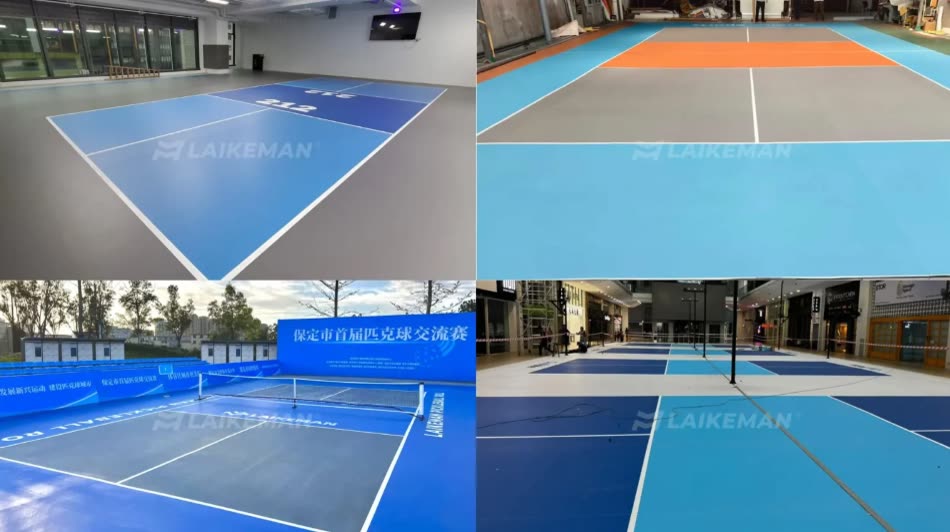
Indoor sports facilities demand surfaces capable of balancing athlete safety with consistent ball behavior. Pickleball courts, for instance, require controlled ball resilience and uniform traction across the playing surface. To meet these specifications, Laikeman engineers dedicated sports surfaces such as the PMT 3.0mm series, which incorporates a specialized acrylic sand coating. This surface design provides predictable ball bounce while offering controlled friction to prevent sudden joint strain during rapid lateral movements. The performance parameters align with standards recognized in professional events organized by organizations like the Professional Pickleball Association.
Badminton and basketball courts require different mechanical characteristics, focusing heavily on vertical deformation and shock absorption. Floors used in these spaces utilize composite foam backings that compress under sudden impact, mitigating force transmitted to an athlete’s knees and lower back. Synthetic surfaces designed for badminton feature distinct textured surface patterns—such as gem, snake-skin, or cloth textures—to maintain predictable friction levels when dry. Proper shock absorption reduces physical fatigue without compromising player stability, making structural foam layers an essential requirement for high-impact sports environments.
Commercial and Specialized Settings: Targeted Wear, Fire, and Slip Resistance
Commercial environments like hospitals, classrooms, and retail centers present operational demands distinct from sports facilities. These high-traffic settings prioritize long-term durability and safety compliance over shock absorption. Surfaces in these spaces typically utilize a dense top layer, often reaching 0.45mm or higher in wear thickness, to withstand continuous foot traffic, heavy wheeled equipment, and rolling furniture. Fire protection remains another mandatory benchmark in public buildings, where materials must achieve at least a B1 flame-retardant rating under standard testing, ensuring low smoke toxicity and self-extinguishing capabilities during emergencies.
Specialized indoor spaces require custom formulation adjustments rather than one-size-fits-all product designs. Aquatic facility peripheries, changing rooms, and wet entryways demand elevated wet-slip resistance ratings, such as R9 or higher, achieved through specialized surface embossing and anti-slip topcoats. Conversely, dance studios require high-elasticity backing layers paired with smooth, non-abrasive surface finishes that allow controlled foot sliding without catching. Xiong County Laikeman Plastic Products Co.,Ltd modifies surface topcoats and backing densities according to the exact functional demands of each distinct setting rather than applying generic material templates across different applications.
Manufacturing Foundation: Dual-Base In-House Production
Product performance in the field relies heavily on precision manufacturing and consistency across production batches. Starting as a specialized manufacturer of PVC calendering film in 2008, Laikeman has expanded into an integrated manufacturing operation featuring dual production sites located in Xiong’an, Hebei Province, and Ulanqab, Inner Mongolia. Operating complete production lines for calendering, laminating, printing, and poly-propylene processing allows full control over raw material mixing, layer alignment, and structural curing. In-house processing removes reliance on third-party suppliers for core components, directly influencing physical parameter consistency.
Quality control mechanisms at the plant level safeguard critical performance parameters. The manufacturing protocol incorporates five distinct quality inspection checkpoints throughout the production process, backed by long-term sample retention for batch traceability. Tensile strength, dimensional retention, flame resistance, and surface adhesion are tested before products leave the factory floor. Physical consistency relies on strictly monitored machinery settings rather than external trading intermediaries. By maintaining full operational control from initial raw resin preparation to final packaging, the company preserves structural uniformity across large volume orders destined for international distribution.
Conclusion: Matching Scenario Parameters for Optimal Performance
Choosing synthetic flooring is ultimately an exercise in matching application demands with physical technical data. No universal sheet configuration serves all operational settings equally well. Buyers achieve long-term performance by evaluating required wear layer thickness, shock absorption rates, flame ratings, and slip resistance against published laboratory test results. Transparent technical data allows architects, contractors, and facility managers to select suitable materials based on empirical parameters rather than generic marketing claims.
As a reliable PVC flooring factory, Laikeman publishes detailed structural specifications, thickness metrics, wear levels, and fire performance ratings for its full product lineup online. Interested buyers can cross-reference project requirements directly against standardized product performance charts. Fully integrated manufacturing facilities back these technical ratings, offering verifiable product consistency for commercial and athletic installations worldwide. Additional product documentation and technical datasheets are available through the official portal at https://lkmfloor.com/
XIONG COUNTY LAIKEMAN PLASTIC PRODUCTS CO.,LTD
XIONG COUNTY LAIKEMAN PLASTIC PRODUCTS CO.,LTD
Legal Disclaimer:
EIN Presswire provides this news content “as is” without warranty of any kind. We do not accept any responsibility or liability
for the accuracy, content, images, videos, licenses, completeness, legality, or reliability of the information contained in this
article. If you have any complaints or copyright issues related to this article, kindly contact the author above.

Media gallery