The Business Research Company’s Cargo Bicycles Global Market Report 2026 – Market Size, Trends, And Forecast 2026-2035
LONDON, GREATER LONDON, UNITED KINGDOM, October 27, 2026 /EINPresswire.com/ — The cargo bicycles market is steadily carving out a significant niche within the broader transportation sector, driven by shifting preferences toward sustainable and efficient urban mobility solutions. As cities grow denser and the demand for last-mile logistics intensifies, cargo bikes are emerging as a practical and eco-friendly alternative. Let’s explore the current market size, key growth factors, leading players, and notable trends shaping this sector’s promising future.
Cargo Bicycles Market Size and Its Place Within the Transport Industry
By 2030, the cargo bicycles market is projected to exceed $14 billion in value. This segment forms a notable part of the larger Motorcycle and Bicycle market, which itself is forecasted to reach around $114 billion by that year. Cargo bicycles are expected to account for roughly 13 percent of this parent market. Looking at the wider Transport industry, set to hit $9,400 billion by 2030, cargo bicycles will represent about 0.2 percent of the total market value, signaling a growing yet still specialized role within global transport solutions.
Request A Free Sample Of The Cargo Bicycles Market Report
https://thebusinessresearchcompany.com/sample_request?id=9051&type=smp&name=Cargo%20Bicycles%20Market%20Report%202026&utm_source=EINPresswire&utm_medium=Paid&utm_campaign=Oct_PR
Asia-Pacific Predicted as the Leading Region in Cargo Bicycles by 2030
The Asia-Pacific region is anticipated to dominate the cargo bicycles market in 2030, with an estimated worth of $4.3 billion. The market there is set to surge from $1.2 billion in 2025 at a remarkable compound annual growth rate (CAGR) of 28 percent. This rapid expansion is largely driven by the booming e-commerce and last-mile delivery sectors in major urban hubs. Logistics and courier companies are increasingly adopting cargo bikes as cost-effective transport options. Additionally, government initiatives to improve cycling infrastructure and promote sustainable urban mobility, along with challenges like rising traffic congestion and population density, contribute to this strong market performance. Asia-Pacific’s manufacturing strength further supports wide-scale production and competitive pricing of cargo bicycles.
United States to Hold the Largest National Market Share for Cargo Bikes in 2030
The United States is projected to be the largest individual country market for cargo bicycles by 2030, valued at $3.1 billion. The market is expected to grow from $1 billion in 2025 at a CAGR of 26 percent. This growth reflects factors such as the expanding footprint of e-commerce delivery services, increased use of cargo bikes by food delivery and courier companies, and stronger corporate commitments to sustainability goals aimed at reducing emissions. Supportive municipal policies encouraging micro-mobility and the use of cargo bicycles for urban freight to alleviate congestion and cut operational costs also contribute to the market’s upward trajectory.
Access The Detailed Cargo Bicycles Market Report Here
https://thebusinessresearchcompany.com/report/cargo-bicycles-global-market-report?utm_source=EINPresswire&utm_medium=Paid&utm_campaign=Oct_PR
Dominance of Electric Cargo Bicycles in the Market by 2030
Within the cargo bicycles market, the electric segment is set to be the largest by type, representing 64 percent of the market or $9 billion by 2030. Factors propelling this dominance include the availability of advanced high-performance battery systems, growing demand for cargo transport solutions with extended range, and the needs of commercial fleet operators seeking higher payload capacity and operational efficiency. Ongoing improvements in motor technology enhance ride quality across different terrains, while manufacturers increasingly focus on smart connectivity and fleet management features, making electric cargo bikes highly attractive for both business and consumer use.
Cargo Bicycle Segmentation by Wheel Size and Application
The cargo bicycles market is categorized by wheel size into two groups: 20 to 24 inches and 25 to 28 inches. Regarding usage, the market segments include personal applications, commercial operations, and other specialized uses, catering to a diverse range of consumers and businesses.
Growth Rate Projection for Cargo Bicycles Through 2030
The cargo bicycles market is expected to grow at a compound annual growth rate of 26 percent leading up to 2030, indicating robust expansion fueled by multiple demand drivers and technological advancements.
Rising Demand for Freight Delivery Fleets as a Key Market Driver
One of the main factors pushing cargo bicycles’ growth is the increasing need for freight delivery fleets. The ongoing rise of e-commerce, grocery delivery, and urban logistics is encouraging businesses to adopt cargo bicycles for transporting goods efficiently in congested city areas. Compared to traditional delivery vehicles, cargo bikes offer lower operating and maintenance costs as well as greater flexibility in navigating traffic. This makes them appealing to logistics providers aiming to boost delivery speed and reduce urban transportation challenges. This demand is expected to add about 2.2 percent annual growth to the market.
Government Support for Environmentally Friendly Transport Boosts Market Expansion
Government efforts promoting eco-friendly transportation options are significantly impacting the cargo bicycles market’s growth. Many countries are implementing policies that support low-emission transport through subsidies, investments in cycling infrastructure, and restrictions on conventional vehicle access in urban centers. These measures encourage both businesses and consumers to choose cargo bicycles as practical, sustainable alternatives for goods transport. The focus on reducing carbon footprints and advancing sustainable mobility is strengthening market adoption, with such initiatives likely contributing roughly 1.9 percent of annual growth.
Increasing Popularity and Adoption of Electric Cargo Bikes Enhances Market Growth
Electric cargo bicycles are becoming a major growth catalyst due to their enhanced load capacity, rider comfort, and ability to cover longer distances while carrying heavy cargo. Developments in battery technology and electric drivetrains improve vehicle performance and reliability, attracting both commercial and personal users. The expanding range of electric models across different price points further encourages widespread adoption. This rising acceptance of electric cargo bikes is projected to add around 1.6 percent in yearly market growth.
Key Growth Opportunities in Electric and Non-Electric Cargo Bicycles
The most promising growth areas lie within both the electric and non-electric cargo bike segments, which together are expected to exceed $10 billion in value by 2030. Drivers include increasing demand for efficient urban cargo transport, the shift toward sustainable last-mile delivery options, rising investments in cycling infrastructure, and broader use of cargo bicycles in commercial logistics. Ongoing innovations in design, durability, and load capacity reflect the industry’s commitment to meeting urban transport needs while supporting low-emission mobility and cost-effective freight solutions.
Market Competition and Focus Areas for Cargo Bicycle Manufacturers
The cargo bicycles market features established bicycle brands, electric mobility providers, and specialized cargo bike producers, all competing by innovating products that emphasize load efficiency, electric-assist integration, modular cargo capabilities, and urban mobility solutions. Companies are expanding their e-cargo offerings, improving battery performance and range, enhancing rider safety and comfort, and developing fleet-oriented solutions to address growing demand for sustainable last-mile transportation. Central to their competitive strategies are payload capacity, durability, operational efficiency, and adaptability to both personal and commercial uses, shaping the future of urban freight and family mobility.
Leading Company Driving the Cargo Bicycles Market Forward
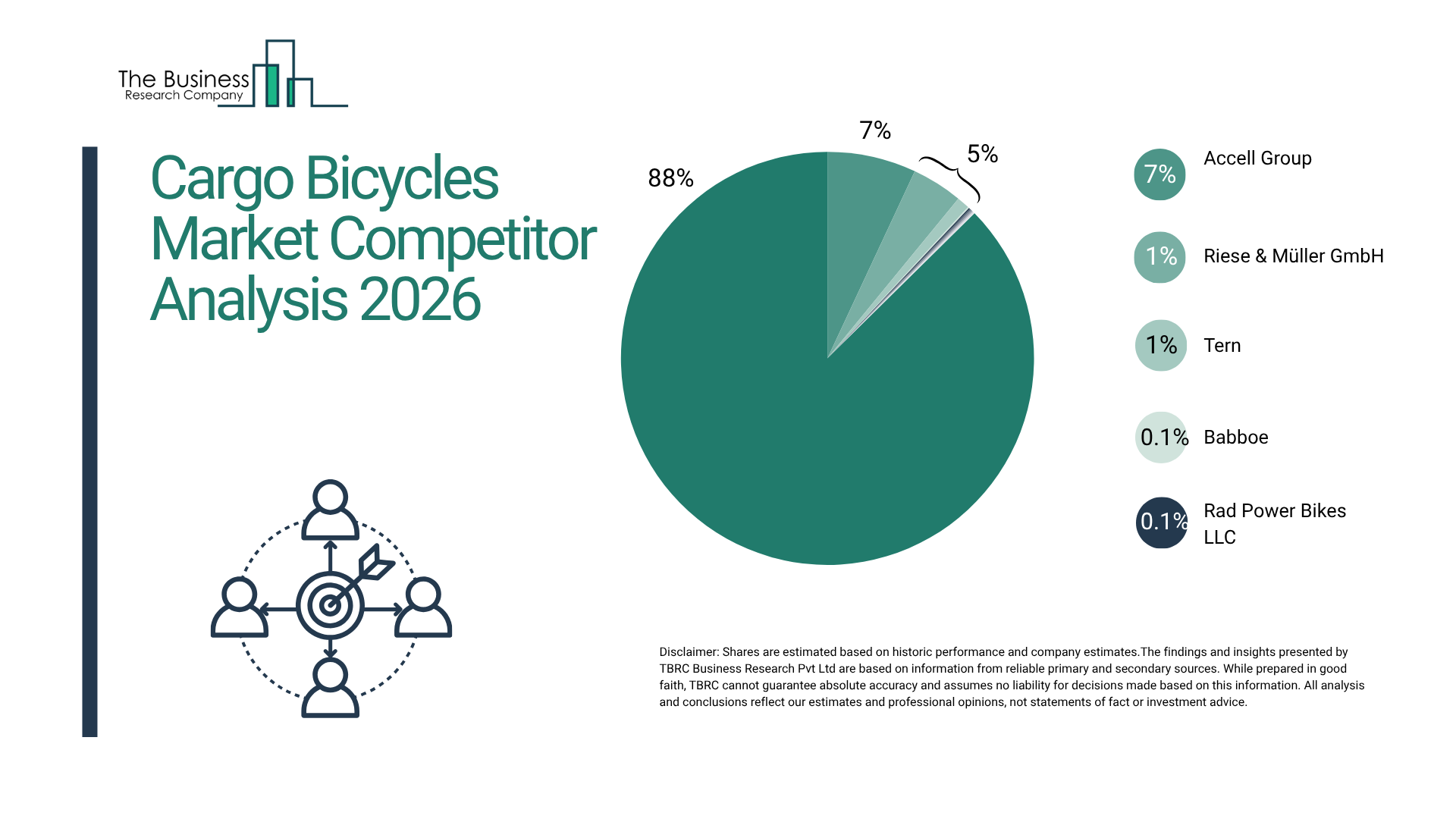
Accell Group stands out as the global leader in cargo bicycle sales, holding a 7 percent market share in 2025. Their portfolio includes a wide variety of electric and traditional cargo bikes designed for urban logistics, family transport, and commercial delivery. Their products emphasize efficient goods movement, rider convenience, reliability, and sustainability for both consumer and business users.
Top Competitors in the Cargo Bicycles Industry
Other significant players in the market include Riese & Müller GmbH, Tern, Babboe, Rad Power Bikes LLC, Urban Arrow, Carqon, Yuba Bicycles LLC, NIHOLA, Bullitt, Gazelle, Butchers & Bicycles Ltd., Xtracycle Inc., TRIOBIKE A/S, Winther Bikes, Bunch Bikes, Benno Bikes, Worksman Cycles, and Christiania Bikes. These companies offer diverse product lines and are actively innovating to meet evolving market demands.
Market Fragmentation and Competitive Landscape
The cargo bicycles market is moderately fragmented, with the top 10 companies collectively accounting for 12 percent of total revenue in 2025. This structure reflects moderate barriers related to product development, distribution, and specialized engineering needs such as electric-assist systems and modular cargo designs. Key players maintain their market shares through strong brand recognition, extensive regional presence, and continuous improvement in design, ergonomics, and electric mobility technology. As demand grows in urban transport, sustainable logistics, family use, and fleet delivery, product differentiation, expanded sales channels, and strategic partnerships will be critical for these companies to enhance their competitive edge.
Key Suppliers of Raw Materials for Cargo Bicycles
The cargo bicycles industry relies on major raw material suppliers like Hydro Extrusions, Constellium SE, Novelis Inc., ArcelorMittal S.A., SSAB AB, thyssenkrupp Materials Services, Toray Industries Inc., Teijin Limited, Covestro AG, BASF SE, SABIC, Evonik Industries AG, Hexcel Corporation, Mitsubishi Chemical Group, UPM Biocomposites, Röchling Group, SGL Carbon SE, Huntsman Corporation, Owens Corning, and LANXESS AG. These suppliers provide critical materials used in frames, batteries, composites, and other components.
Prominent Wholesalers and Distributors Supporting the Cargo Bicycles Market
Major wholesalers and distributors include Pon.Bike, QBP, Hartje KG, JBI.Bike, Trek Bicycle Dealer Network, Giant Bicycle Distribution Network, Specialized Bicycle Dealer Network, Cycling Sports Group, Velorution, Bike24 AG, Internetstores GmbH, Cyclable, Wheel & Sprocket, Bike-Components, Evans Cycles, Rutland Cycling, Mike’s Bikes, 99 Bikes, and Performance Bicycle. These companies facilitate broad product availability and after-sales support across key markets.
Primary End Users Driving Cargo Bicycle Demand
Key end users encompass major logistics and delivery firms such as DHL Express, United Parcel Service (UPS), FedEx Corporation, Deutsche Post DHL Group, Amazon Logistics, DPDgroup, GLS Group, Royal Mail Group, PostNL N.V., La Poste Group, as well as food delivery platforms like Uber Eats, DoorDash Inc., Deliveroo plc, Just Eat Takeaway.com, Instacart, and large retail chains including Walmart Inc., Tesco plc, Carrefour S.A., IKEA, and Ocado Group. Their adoption of cargo bicycles reflects growing emphasis on sustainable urban logistics.
Competitive Trends Transforming the Cargo Bicycles Market
Innovation in longtail electric cargo bikes is revolutionizing urban transportation by enhancing flexibility, load capacity, and family and commercial mobility options. For example, Urban Arrow introduced the Breeze in October 2025, its first longtail electric cargo bike, which merges the maneuverability of a traditional bike with substantial cargo capabilities. Features such as an extended rear carrier able to carry up to 80 kg, a Bosch Cargo Line motor delivering 85 Nm torque, a modular accessory system, and multiple battery choices improve rider comfort, transport versatility, and operational efficiency for both family and commercial users.
Strategic Moves Companies Are Making to Stay Competitive
To maintain a leading edge, companies are accelerating the adoption of electric cargo bikes to support urban last-mile delivery, developing modular cargo platforms that enhance versatility, integrating smart connectivity to improve fleet management and rider experience, and expanding family-oriented cargo bike models that promote sustainable urban living. These strategies address evolving market needs while fostering growth and innovation.
Our 2026 reports feature deeper market intelligence with market attractiveness scoring and analysis, total addressable market (TAM) analysis, company scoring matrix graphics and tables, Excel-based forecasting dashboards, market hotspots infographics, key technologies and future trend analysis, and updated graphics and tables.
Learn More About The Business Research Company
The Business Research Company (www.thebusinessresearchcompany.com) is a leading market intelligence firm renowned for its expertise in company, market, and consumer research. We have published over 30,000+ reports across 27 industries and 60+ geographies. Our research is powered by 1,500,000 datasets, extensive secondary research, and exclusive insights from interviews with industry leaders.
We provide continuous and custom research services, offering a range of specialized packages tailored to your needs, including Market Entry Research Package, Competitor Tracking Package, Supplier & Distributor Package and much more.
Disclaimer: Please note that the findings, conclusions and recommendations that TBRC Business Research Pvt Ltd delivers are based on information gathered in good faith from both primary and secondary sources, whose accuracy we are not always in a position to guarantee. As such TBRC Business Research Pvt Ltd can accept no liability whatever for actions taken based on any information that may subsequently prove to be incorrect. Analysis and findings included in TBRC reports and presentations are our estimates, opinions and are not intended as statements of fact or investment guidance.
Contact Us:
The Business Research Company
Americas +1 310-496-7795
Europe +44 7882 955267
Asia & Others +44 7882 955267 & +91 8897263534
Email: marketing@tbrc.info
Follow Us On:
LinkedIn: https://in.linkedin.com/company/the-business-research-company
Oliver Guirdham
The Business Research Company
7882 955267
Visit us on social media:
LinkedIn
Facebook
X
Legal Disclaimer:
EIN Presswire provides this news content “as is” without warranty of any kind. We do not accept any responsibility or liability
for the accuracy, content, images, videos, licenses, completeness, legality, or reliability of the information contained in this
article. If you have any complaints or copyright issues related to this article, kindly contact the author above.

Media gallery